

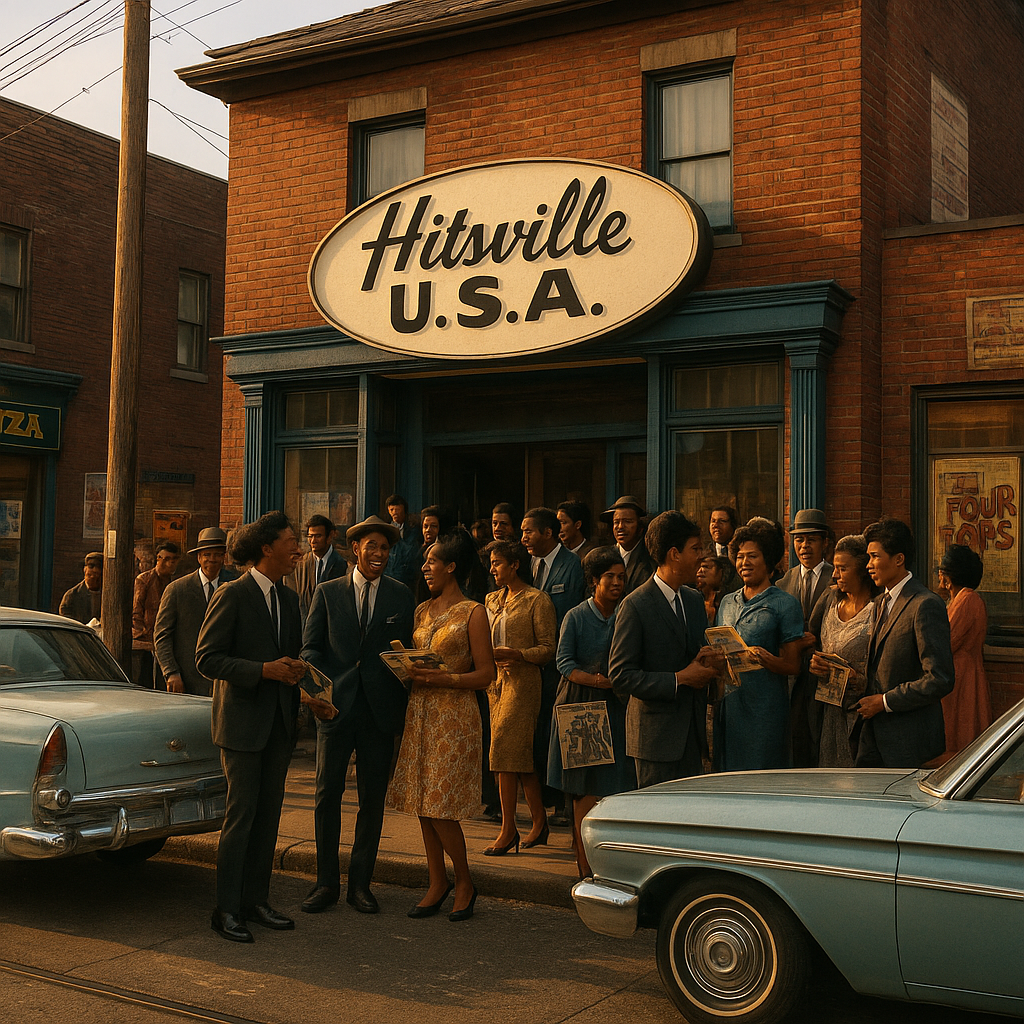
In January 1959, a young Detroit songwriter named Berry Gordy Jr. borrowed $800 from his family’s loan fund and used it to start a record label. Operating out of a modest two-story house at 2648 West Grand Boulevard — a building he grandly christened “Hitsville U.S.A.” — Gordy built what would become one of the most consequential cultural institutions in American history. Motown Records didn’t just produce hit songs. It reshaped racial attitudes, created a blueprint for Black entrepreneurship, and gave the world a sound so distinctive that, more than six decades later, it remains instantly recognizable from the first few bars.
Understanding the cultural significance of Motown Records means looking beyond the music itself, extraordinary as that music is. It means examining what the label represented during one of the most turbulent periods in American life, and why its influence continues to reverberate through pop culture today.
The Birth of Hitsville: Motown’s Origins in Detroit
Berry Gordy was a former assembly line worker at Ford’s Wayne plant, and that experience profoundly shaped his approach to making records. He famously described wanting to create a place where “a kid off the street could walk in one door and come out the other a polished performer.” The result was a hit factory in the truest sense — a vertically integrated operation where songwriting, production, artist development, choreography, and even etiquette training all happened under one roof.
The name itself tells a story. “Motown” is a contraction of “Motor Town,” a nod to Detroit’s identity as the heart of the American automobile industry. Gordy applied the assembly line logic of car manufacturing to music production, with remarkable results. Between 1961 and 1971, Motown racked up 110 top ten hits — a staggering achievement for any label, let alone an independent Black-owned company competing against established industry giants.
The first major breakthrough came in 1961 with The Marvelettes’ “Please Mr. Postman,” which became the label’s first number one pop hit. From there, the floodgates opened.
Defining the Motown Sound
What exactly makes a Motown song sound like a Motown song? Musicologists and fans have debated this for decades, but several defining characteristics emerge consistently:
- The backbeat: Motown recordings almost universally emphasize beats two and four, often with a tambourine or snare driving the rhythm. This created an irresistible, danceable pulse that became the label’s sonic signature.
- Melodic bass lines: James Jamerson, the legendary bassist of the Funk Brothers (Motown’s in-house band), played bass lines that functioned almost as counter-melodies — complex, fluid, and endlessly inventive.
- Call-and-response vocals: Rooted in gospel traditions, the interplay between lead singers and background vocalists (often fellow label stars) gave Motown records a communal, church-inflected energy.
- Lush orchestral arrangements: Strings and horns sat alongside the rhythm section, creating a polished, sophisticated sound that distinguished Motown from the rawer Southern soul coming out of Stax and Muscle Shoals.
- Universal lyrics: Motown songwriters — particularly the team of Holland-Dozier-Holland — specialized in songs about love and heartbreak that avoided explicit racial or political content, making them accessible to the widest possible audience.
The Funk Brothers, Motown’s largely uncredited studio musicians, deserve special mention. This rotating group of Detroit jazz and R&B players performed on hundreds of hit records and arguably created the Motown sound as much as any of the headline artists. Their contributions helped lay the groundwork for the evolution of funk music in the decades that followed. The 2002 documentary Standing in the Shadows of Motown finally gave many of them long-overdue recognition.
The Artists Who Defined an Era
Motown’s roster during its golden era reads like a hall of fame unto itself. The label was home to The Supremes, The Temptations, The Four Tops, Martha and the Vandellas, Marvin Gaye, Stevie Wonder, Smokey Robinson and the Miracles, The Jackson 5, Gladys Knight and the Pips, and many more. These weren’t just successful recording acts — they were cultural ambassadors whose polished performances brought Black artistry into American living rooms via shows like The Ed Sullivan Show and, later, through Motown’s own television specials.
The Supremes alone scored twelve number one singles on the Billboard Hot 100, making them one of the most successful vocal groups in American history. When The Jackson 5’s “I Want You Back” exploded in 1969, it launched what would become the most significant career in pop music history — Michael Jackson’s.

Interestingly, while Motown is rightly celebrated as a Black institution, the label did sign a small number of white artists. The most frequently cited is Rare Earth, a rock band signed in 1969 to Motown’s rock-oriented subsidiary (also called Rare Earth). They scored hits with covers of “Get Ready” and “(I Know) I’m Losing You” and remain the answer to one of the most common trivia questions about the label. Singer Bobby Darin also recorded for Motown in the early 1970s, though with less commercial impact.
Motown and the Civil Rights Movement
Perhaps no aspect of Motown’s cultural significance is more debated than its relationship to the civil rights movement. Berry Gordy deliberately crafted a crossover strategy — elegant presentation, polished choreography, and love-centered lyrics designed to appeal to white audiences without confrontation. Critics at the time and since have questioned whether this approach represented a form of accommodation or a shrewd and effective form of cultural diplomacy.
The truth is likely both more complicated and more powerful than either framing suggests. Motown didn’t march, but it integrated. It put Black faces, Black voices, and Black creativity into the mainstream of American life at a time when segregation was still legally enforced in much of the South. When The Supremes appeared on national television looking glamorous and sounding magnificent, it sent a message that transcended lyrics.
Gordy also made a direct contribution to the movement. In 1963, Motown released “The Great March to Freedom,” a spoken-word album featuring Martin Luther King Jr.’s speech at the Detroit Walk to Freedom — a precursor to the famous March on Washington. Later, the label’s Black Forum imprint released recordings of King’s speeches and other politically significant material.
By the late 1960s, the music itself was becoming more explicitly engaged. Marvin Gaye’s “What’s Going On” (1971) — which Gordy initially resisted releasing — became a landmark of socially conscious soul, addressing war, poverty, and environmental destruction. Stevie Wonder’s work in the 1970s similarly pushed into political territory, most notably with “Living for the City” and his campaign to make Martin Luther King Jr.’s birthday a national holiday.
Motown as a Business and Cultural Blueprint
Beyond its musical output, Motown represented something revolutionary: a highly successful, nationally prominent Black-owned business. At its peak in the late 1960s, Motown was the largest Black-owned corporation in the United States. In an era of systemic economic exclusion, Gordy demonstrated that Black entrepreneurship could compete at the highest levels of American industry.
The Motown model — artist development, quality control (Gordy famously held weekly product evaluation meetings where songs competed for release), brand consistency, and strategic crossover marketing — has influenced virtually every successful label and entertainment company that followed. You can draw a straight line from Hitsville to modern K-pop’s trainee system, to hip-hop empires like Bad Boy and Roc-A-Fella, and to the way contemporary pop stars are developed and marketed. The cultural impact of Motown’s visual identity and branding is comparable to how murals can transform a community through deliberate artistic expression and cultural messaging.
Motown’s Biggest Hits: By the Numbers
Pinpointing Motown’s single biggest hit depends on how you measure it. In terms of pure sales, “Endless Love” by Diana Ross and Lionel Richie (1981) is often cited as the label’s best-selling single. “I Heard It Through the Grapevine” by Marvin Gaye was Motown’s biggest hit of the 1960s, spending seven weeks at number one. But if we’re talking about cultural footprint — the song most universally associated with the Motown sound — arguments could be made for The Supremes’ “Stop! In the Name of Love,” The Temptations’ “My Girl,” or The Jackson 5’s “I Want You Back.” The Temptations’ “My Girl,” written by Smokey Robinson, may be the most enduring: it was inducted into the Grammy Hall of Fame and remains a fixture of American popular culture.
The Move West and Later Years
In 1972, Berry Gordy relocated Motown’s headquarters from Detroit to Los Angeles, a move that symbolized the label’s evolution from regional hit factory to diversified entertainment company. Motown expanded into film and television, producing projects like Lady Sings the Blues (1972), which earned Diana Ross an Academy Award nomination.
The move was commercially logical but culturally complicated. Detroit’s identity was woven into Motown’s DNA, and many fans and historians feel the label lost something intangible when it left. Gordy sold the company to MCA and Boston Ventures in 1988 for $61 million (a figure that struck many observers as surprisingly low given the catalog’s value), ending an era of independent Black ownership.
Today, the Motown catalog is controlled by Universal Music Group, but the brand endures. The Motown Museum, housed in the original Hitsville U.S.A. building, draws visitors from around the world. The 2013 Broadway musical Motown: The Musical introduced the story to new audiences, and contemporary artists from Beyoncé to Bruno Mars regularly cite Motown as a primary influence.
Why Motown Still Matters
Motown Records occupies a unique place in American cultural history. It was simultaneously a hit-making machine, a symbol of Black excellence and economic self-determination, a bridge across racial divides, and a masterclass in brand building and artist development. The label proved that Black music, presented with uncompromising quality and ambition, wasn’t a niche product — it was American music, full stop.
The specific achievements are staggering: hundreds of hit records, dozens of careers launched, a sound that defined a decade. But the deeper significance lies in what Motown demonstrated about the relationship between culture and change. Berry Gordy didn’t set out to make protest music. He set out to make great music and build a great business. In doing both, he helped transform the cultural landscape of a nation.
That legacy isn’t confined to nostalgia. Every time a young artist meticulously crafts their image, every time a label invests in long-term artist development, every time a song crosses demographic boundaries to become a shared cultural touchstone, the Motown model is at work. The little house on West Grand Boulevard may look modest, but what happened inside it changed the world.