
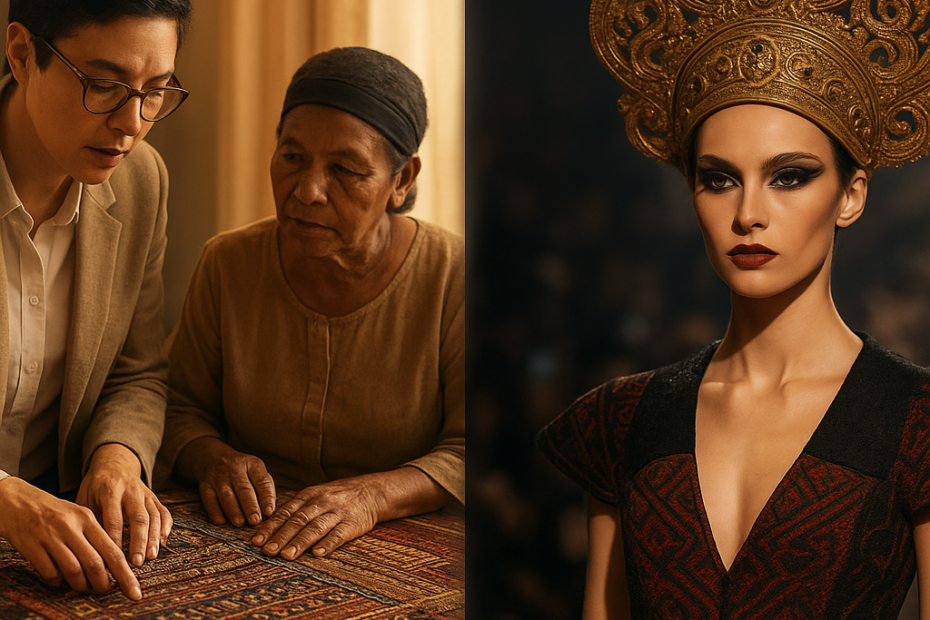
Fashion has always been a global conversation — a visual language that borrows, blends, and evolves across borders and centuries. But in recent years, that conversation has gotten a lot louder, and a lot more complicated. When a luxury brand sends models down the runway in sacred Indigenous headdresses, or when a fast-fashion label mass-produces bindis as festival accessories, something feels off — even if it’s hard to articulate exactly why. At the same time, when a designer collaborates deeply with an artisan community to bring their textile traditions to a wider audience, something feels genuinely beautiful about that exchange.
So where exactly does the line fall? The debate between cultural appropriation and cultural appreciation in fashion is one of the most nuanced conversations happening in culture right now, and it rarely gets the careful treatment it deserves. This article takes a serious look at the distinction — not to hand down verdicts, but to build a framework for thinking more clearly about when fashion celebrates culture and when it exploits it.
Understanding the Core Difference: Appropriation vs. Appreciation
Before unpacking fashion-specific examples, it helps to get the terminology right — because these two words are often used interchangeably when they describe very different dynamics.
Cultural appreciation is the respectful engagement with another culture’s practices, art forms, or traditions. It involves learning, acknowledging origins, and often working alongside members of that culture to honor what those elements mean. Cultural appropriation, on the other hand, involves adopting elements of a marginalized culture — usually by someone from a dominant culture — without credit, context, or understanding, and often for profit or aesthetic novelty.
The distinction isn’t always clean, but a few key questions help clarify things:
- Does the original culture benefit from how their traditions are being used?
- Is the cultural element being stripped of its meaning or significance?
- Are members of that culture being consulted, credited, or included?
- Is there a history of that culture being marginalized or mocked for the same practices now being celebrated in a different context?
That last point is particularly sharp. When Black women were penalized in professional settings for wearing natural hair and locs — only for those same styles to be praised as “edgy” or “boho” when worn by white models — that’s a textbook example of appropriation as a structural issue, not just a fashion faux pas.
A Brief History of Fashion’s Complicated Relationship With Culture
Fashion has borrowed across cultures for as long as trade routes existed. European fashion houses in the early 20th century drew heavily from East Asian, North African, and South Asian aesthetics — often without any acknowledgment of where those influences came from. Paul Poiret’s “Oriental” collections in the 1910s were celebrated as revolutionary, even as they reduced complex cultures to costume fodder for Western consumers.
The pattern continued through the decades. In the 1960s and 70s, “ethnic” fashion was a marketing category. In the 1990s and 2000s, tribal prints and “exotic” embroidery became fast-fashion staples. The industry had a habit of lifting aesthetics while leaving behind the communities that created them.
But the social media era changed the accountability landscape significantly. When Urban Outfitters sold Navajo-branded products without permission, the Navajo Nation filed a federal lawsuit under the Indian Arts and Crafts Act — and won a settlement in 2016. When Gucci sent white models down the runway in Sikh turbans in 2018, the global backlash was immediate and unambiguous. These moments signaled that the old rules — or lack thereof — were no longer acceptable.
Real-World Examples: Where Fashion Has Gotten It Wrong
The Headdress Problem
Few symbols have been more consistently mishandled in fashion than the Plains Indian war bonnet. Sacred within many Native American traditions, the headdress is an earned symbol of honor and leadership — not a costume accessory. Yet it has appeared repeatedly in music festival fashion, Halloween costumes, and high-fashion editorial shoots, worn by people with no cultural connection to it whatsoever.

Victoria’s Secret notably faced sharp criticism in 2012 when a model wore a headdress as part of a lingerie look. The brand apologized and pulled the segment from the televised broadcast. But the apology didn’t address the deeper pattern: the fashion industry’s tendency to treat Indigenous iconography as an aesthetic resource.
Cornrows, Locs, and the Double Standard
Marc Jacobs caused significant controversy in 2016 when he sent white models down the runway wearing faux locs, dismissing the criticism by claiming that “we don’t see color.” The problem wasn’t the hairstyle itself — it was the decontextualization of a protective style rooted in African culture, combined with a refusal to acknowledge that Black people have faced real discrimination for wearing the same styles in workplaces and schools. Kim Kardashian calling her box braids “Bo Derek braids” — erasing their African origin entirely — is another frequently cited example of this pattern.
The Bindi as Fashion Accessory
The bindi, a forehead marking with deep roots in Hindu religious and cultural practice, became a mainstream Western fashion trend largely thanks to music festival culture in the 2010s. Worn without any understanding of its significance — spiritual, marital, regional — it became purely decorative, often sold in packs at party supply stores. South Asian women who wear bindis as part of their actual cultural identity have spoken at length about the frustration of watching a sacred element of their heritage turned into a novelty item. This dynamic — where music shapes fashion trends in ways that strip cultural symbols of their meaning — is a recurring tension worth examining more closely.
When Fashion Gets It Right: Genuine Appreciation in Practice
Appreciation isn’t just the absence of appropriation — it’s an active, thoughtful process. Several designers and brands have shown that fashion can engage with other cultures in ways that are genuinely respectful and mutually beneficial.
Collaboration Over Extraction
Stella Jean, the Haitian-Italian designer, has built her entire practice around a model of authentic collaboration. She works directly with artisan communities in Haiti, West Africa, and other regions, ensuring that the craftspeople are fairly compensated, credited, and involved in how their traditions are represented. Her work doesn’t just borrow — it elevates and amplifies.
Similarly, the Mexican brand Pineda Covalin works with Indigenous artisans to produce textiles that celebrate traditional Mexican imagery while keeping the cultural knowledge and economic benefit within the communities that originated those traditions. This is the model that appreciation looks like in practice.
Context and Credit Change Everything
When Valentino featured African-inspired prints in a 2015 collection, the backlash was significant — the collection featured almost exclusively white models and offered no acknowledgment of the African origins of the textiles and silhouettes. Compare that to designers like Ozwald Boateng or Duro Olowu, who bring West African tailoring traditions into global fashion with full cultural fluency and deep personal connection. The difference isn’t just who’s doing it — it’s how, and with what level of understanding and respect.
The Role of Power in the Appropriation Debate
One of the most important — and often overlooked — dimensions of this conversation is power. Cultural exchange has always existed. Cultures have influenced each other throughout human history, and that influence isn’t inherently negative. What makes appropriation harmful is the power differential involved.
When a dominant culture borrows from a marginalized one — particularly one that has been colonized, discriminated against, or erased — without acknowledgment or benefit-sharing, it compounds existing injustice. The dominant culture profits aesthetically and financially while the originating community receives nothing, or worse, continues to face discrimination for the same practices.
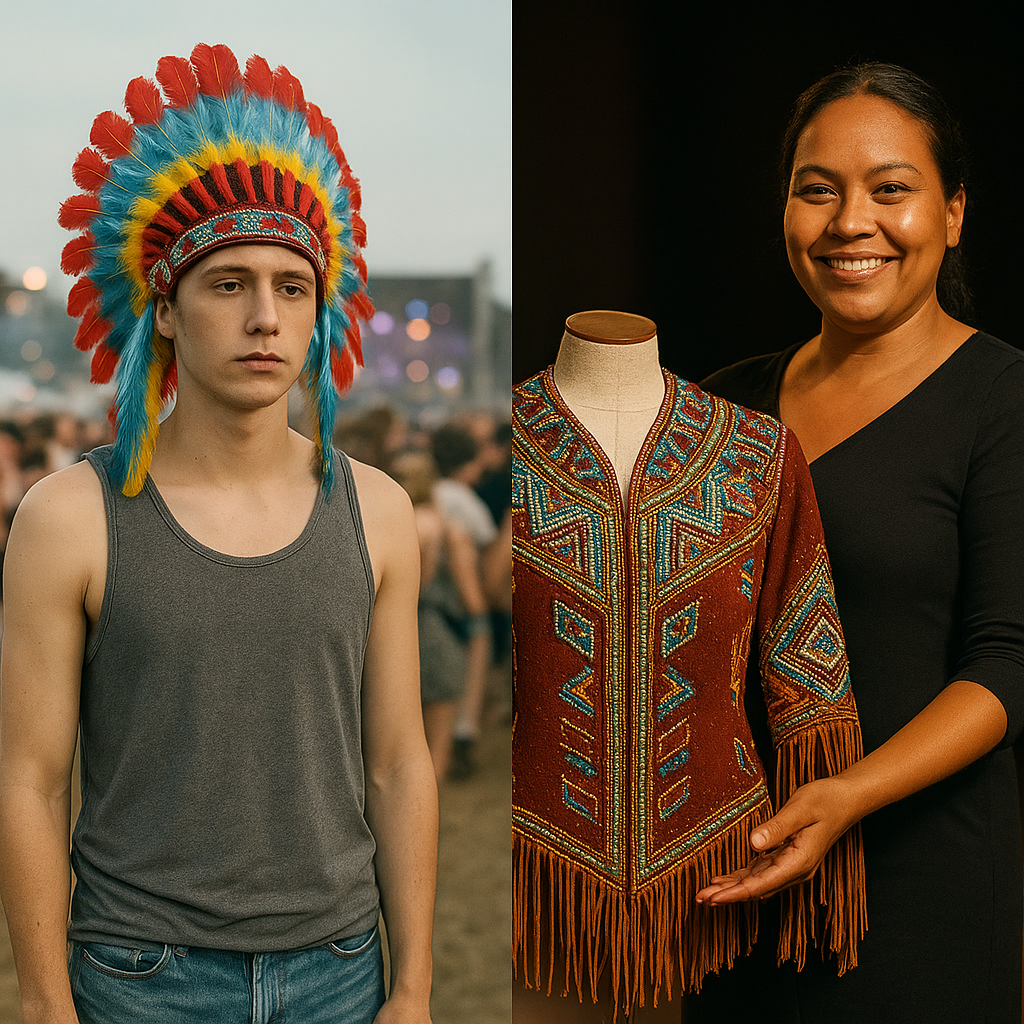
This is why the argument “fashion has always borrowed from everywhere” misses the point. The issue isn’t exchange — it’s exploitation. It’s the fact that a white designer can build a lucrative career around West African kente cloth patterns while Ghanaian weavers struggle for market access. It’s the fact that Native American-inspired fashion is a billion-dollar industry in which actual Native American designers remain largely marginalized. Much like public art can transform community identity, fashion has the power to either honor or erase the cultures it draws from.
Practical Guidelines: How to Think About Fashion and Cultural Influence
For designers, brands, and consumers alike, navigating this terrain thoughtfully requires more than good intentions. Here are some questions and principles worth keeping in mind:
- Research before you wear or design: Understanding the origin and significance of a cultural element is the bare minimum. If something is sacred or ceremonial, that matters — a lot.
- Follow the credit: Appreciation always acknowledges its sources. If a brand can’t name where their “tribal print” comes from, that’s a red flag.
- Ask who benefits: If a cultural aesthetic is generating profit, is any of that flowing back to the originating community? Collaboration and fair trade sourcing matter.
- Listen to community voices: When members of a culture say something is harmful, that deserves weight — even if your intention was celebratory.
- Support designers from the culture: One of the most direct ways to appreciate a cultural tradition is to buy from designers who are actually part of it.
The Consumer’s Role in This Conversation
It would be easy to put all the responsibility on designers and brands — and they do bear significant accountability. But consumers shape markets. Every purchase is a signal about what’s acceptable, what’s desirable, and what the industry should keep producing.
This doesn’t mean every buying decision needs to come with an anthropological research session. But developing a habit of asking basic questions — where does this design come from, who made it, does this brand have a history of respectful sourcing — can meaningfully shift demand over time. Consumers who push back on appropriative products through social media, who choose to support Indigenous or minority-owned fashion brands, and who engage critically with marketing that exoticizes cultures are all playing a role in reshaping industry norms.
According to a 2021 McKinsey report on fashion and social responsibility, consumer pressure remains one of the top drivers of industry change. That’s not an abstract fact — it’s an indication that collective cultural awareness translates into real market shifts.
Conclusion: A More Thoughtful Fashion Future
The line between cultural appropriation and appreciation in fashion isn’t always obvious, but it’s rarely invisible either. It shows up in whether a brand names its sources or erases them. It shows up in whether artisans are partners or props. It shows up in whether a sacred symbol is worn with understanding or worn as a trend.
Fashion at its best is a form of cultural storytelling — a way of honoring history, expressing identity, and building bridges across difference. That kind of exchange is genuinely beautiful. But it requires intentionality, humility, and a willingness to listen to communities whose traditions are being engaged with.
The conversation around cultural appropriation isn’t about policing creativity or building walls between cultures. It’s about asking who benefits, who gets erased, and who holds the power in any given exchange. When fashion asks those questions honestly and designs accordingly, it becomes something worth celebrating — a true meeting of cultures, rather than a one-sided extraction.